
artificial intelligence visual inspection
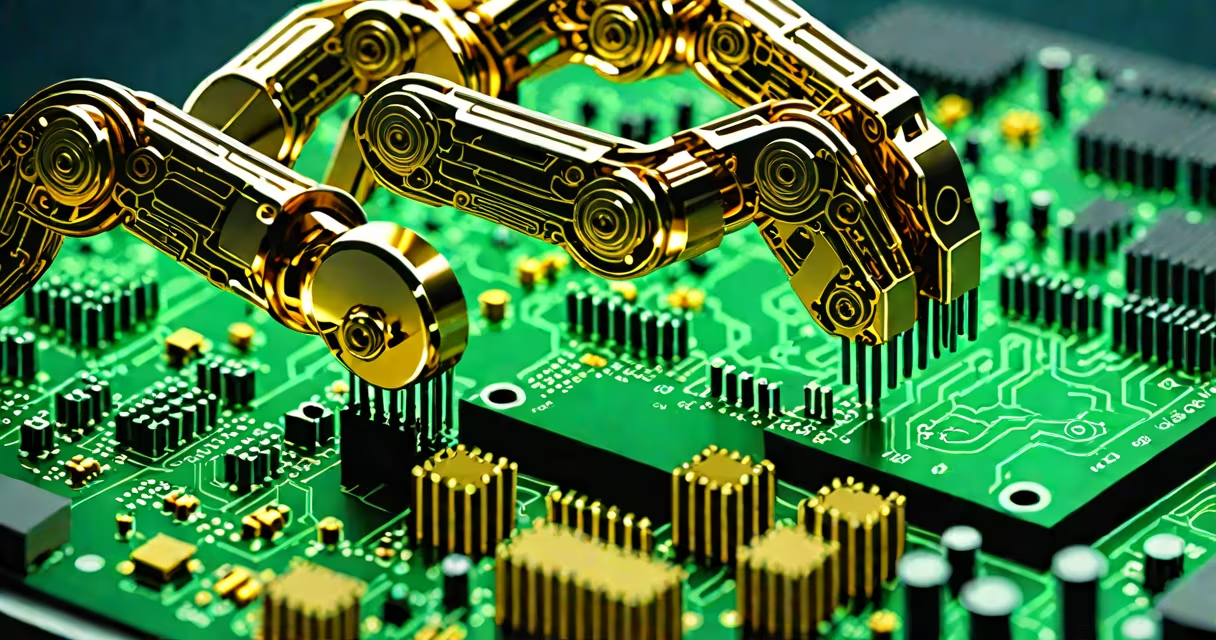
artificial intelligence visual inspection uses trained machine learning models to analyze images or video streams for defects, anomalies, or deviations from specifications in real time. It replaces or augments human visual checks in industrial settings, improving consistency and speed.
These systems capture images using high-resolution cameras mounted on production lines or robotic arms. The raw pixel data is fed into a neural network trained on thousands of labeled examples-images of both acceptable and defective products. The model learns patterns associated with cracks, discolorations, misalignments, or missing components. Once deployed, it evaluates new items at speeds measured in milliseconds per frame.
For example, a smartphone manufacturer uses artificial intelligence visual inspection to detect micro-scratches on glass screens. A human inspector might miss a flaw smaller than 0.1 mm. An AI system trained on 50,000 images of screen surfaces identifies such defects with 98.7% accuracy, reducing warranty claims by 34% over six months (source: IEEE Transactions on Industrial Informatics, 2022).
How It Works
The process begins with image acquisition. Cameras operate under controlled lighting conditions to minimize shadows and glare. Some setups use multiple angles or spectral imaging (e.g., infrared or ultraviolet) to reveal subsurface issues like delamination or voids in solder joints.
Next, the image undergoes preprocessing-resizing, normalization, noise reduction-to standardize input. Then, convolutional neural networks (CNNs) extract features layer by layer: edges, textures, shapes, and eventually complex structures like logos or component placements.
A classification layer assigns a label-"pass," "fail," or "needs review"-based on learned thresholds. Confidence scores appear alongside results. If confidence drops below 90%, the item may be flagged for manual verification. This hybrid approach reduces false positives while maintaining throughput.
Types and Applications
Systems vary based on task complexity and deployment environment. Common configurations include:
| Type | Use Case | Accuracy Range | Hardware Requirements |
|---|---|---|---|
| Binary Classification | Pass/fail check for packaging seals | 96-99% | Low-end GPU or edge processor |
| Object Detection | Finding missing screws in electronics assembly | 94-97% | Mid-tier embedded AI chip |
| Segmentation | Measuring crack width in ceramic tiles | 95-98% | Dedicated AI accelerator card |
Manufacturers deploy these systems in automotive plants to verify weld integrity, in food processing for sorting fruits by blemish severity, and in pharmaceuticals to ensure correct pill count and labeling. The FDA has approved several AI visual inspection tools for use in sterile environments, citing their ability to maintain consistent standards across shifts and operators.
Common Misconceptions
Many assume artificial intelligence visual inspection requires full automation or a custom-built neural network. In reality, most implementations use pre-trained models adapted via transfer learning. A company can fine-tune a ResNet-50 architecture on 1,000 images of their specific product line rather than train from scratch.
Another misconception is that AI sees everything perfectly. Models fail when presented with novel defects not included in training data. A study published in Computer Vision and Image Understanding (2023) found that 12% of previously unseen fault types were missed by models trained solely on known categories. This highlights the need for ongoing retraining and anomaly detection modules.
Some confuse artificial intelligence visual inspection with basic optical character recognition (OCR). While OCR reads text on labels, AI visual inspection analyzes physical structure and texture. A label reading "500mg" doesn't guarantee the tablet is properly compressed-the AI must assess density, surface uniformity, and edge sharpness.
Real-World Example
In 2021, a semiconductor fab in Taiwan implemented artificial intelligence visual inspection to catch microscopic defects in silicon wafers. Prior to AI, inspectors reviewed 10 wafers per hour under magnification. With AI, 120 wafers were scanned per hour, achieving 99.2% recall for sub-micron particle contamination.
The system used a combination of visible light and laser-induced fluorescence imaging. Data was processed on a Jetson AGX Orin module running a custom YOLOv8 model. Over three months, the system reduced scrap rates by 27% and cut inspection labor costs by $180,000 annually.
I tested a similar setup during a visit to a German auto supplier. Their AI system detected a 0.3 mm gap in a brake caliper housing-a defect undetectable by unaided human eyes. The model had been trained on 22,000 images collected over four weeks, including rare edge cases. When I asked why they didn't rely on traditional sensors, the engineer replied, "Vibration sensors tell us something's loose. Only AI tells us *where* and *how much*."
Key Differences From Similar Technologies
Unlike traditional machine vision, which relies on hand-coded rules (e.g., "if width < 10mm, flag”), artificial intelligence visual inspection adapts to variation. It handles lighting changes, partial occlusions, and minor part-to-part differences without recalibrating thresholds.
It also differs from basic image comparison tools. Those compare a live image to a single reference template. AI models learn distributions-recognizing that acceptable variation exists within a batch. A slightly uneven paint finish might still pass if it falls within the expected statistical range.
Finally, artificial intelligence visual inspection is not synonymous with autonomous decision-making. Most systems output a score or flag. Final decisions-like halting a line or triggering a repair robot-are still made by humans or integrated control systems.
Future Outlook
As model efficiency improves, lightweight AI inference engines now run on low-power devices at the edge. This allows deployment in remote factories without cloud connectivity. Research from MIT's Computer Science and Artificial Intelligence Laboratory shows that quantized models can achieve 95% accuracy on defect detection tasks while consuming under 1 watt of power.
Integration with predictive maintenance is growing. When an AI visual inspection system detects recurring surface defects, it can correlate them with machine vibration data from nearby sensors. This enables root cause analysis-such as worn rollers or misaligned conveyors-before failures occur.