
What Does a Goat Look Like
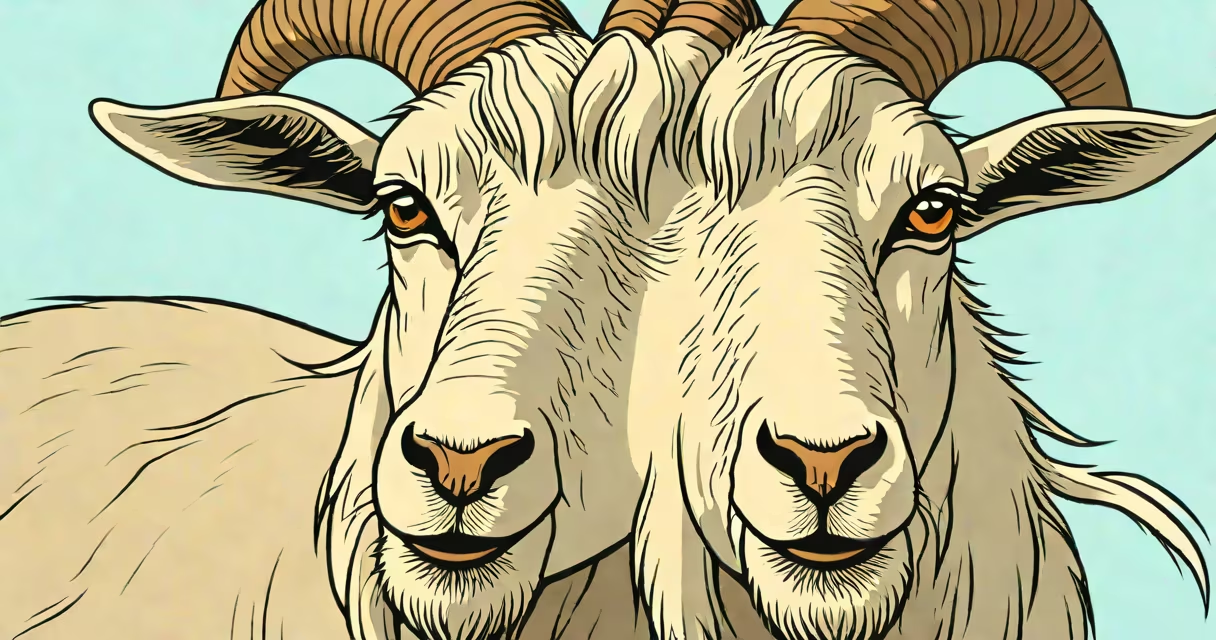
A goat is a small, stocky mammal with a distinct appearance: curved horns, backward-pointing ears, a short tail, and often a beard. It walks on hooves, has a broad chest, and moves with agility across rocky terrain. Goats are domesticated and wild species, varying in coat color and texture.
Goats belong to the genus Capra and are part of the Bovidae family. They evolved in mountainous regions of Eurasia and have adapted to steep, uneven ground. Their hooves are split into two toes with a hard outer edge and soft inner pad, allowing them to grip rock surfaces. This structure enables climbing on cliffs and narrow ledges with ease.
The average adult goat stands 60-80 cm tall at the shoulder and weighs between 30-70 kg. Males (bucks) typically have larger horns than females (does), though horn size varies by breed. Horns grow continuously and may curve forward, backward, or spiral depending on genetics. Some breeds, like the Nubian or Alpine, have long, drooping ears. Others, such as the Pygmy goat, have shorter, upright ears.
Key Physical Features
Goats display several consistent anatomical traits. The most recognizable is their facial structure: a short snout with a split upper lip, which allows precise manipulation of food. Their eyes are positioned high on the head, giving a wide field of vision-up to 320 degrees-helping detect predators. Their pupils are horizontal, a trait shared with prey animals.
Coat variation is extensive. Domestic goats come in solid colors (black, white, brown), spotted patterns, or mixed hues. Coat length ranges from short and sleek (like the Boer goat) to long and woolly (such as the Angora goat). Wild goats, like the ibex, have coarse, dark fur suited to cold alpine climates.
| Breed | Horn Shape | Ears | Coat Type | Typical Color |
|---|---|---|---|---|
| Nubian | Long, curved backward | Long, drooping | Short, smooth | White, black, or brown |
| Pygmy | Short, curved forward | Short, upright | Short, dense | Black, red, or cream |
| Angora | Often absent or small | Medium, upright | Long, silky | White, gray, or black |
Goats often have a beard-a tuft of longer hair beneath the chin-especially in males. This feature is more pronounced in certain breeds, such as the Nigerian Dwarf or the Spanish goat. Beards serve no known functional purpose but contribute to the animal's distinctive look.
Common Misconceptions
Many people confuse goats with sheep due to similar size and grazing habits. However, goats have vertical, slit-shaped pupils, while sheep have horizontal, rectangular pupils. Goats also walk with a bouncing gait and frequently stand on their hind legs to reach high branches. Sheep move with a slower, more deliberate pace and rarely climb.
Another frequent error is assuming all goats are horned. While many wild and traditional breeds carry horns, some domesticated lines have been selectively bred to lack them. These are called polled goats. According to the American Goat Society, approximately 15% of registered dairy goats are polled, though horn removal is still common in commercial operations.
Goats are also sometimes mistaken for antelope or deer. Unlike deer, goats do not shed antlers annually. Antlers are bony structures grown and lost each year; horns are permanent, keratin-covered projections. Goats never shed their horns.
Real-World Example: A Day in the Life of a Mountain Goat
In the Rocky Mountains, the Rocky Mountain goat (Oreamnos americanus) lives above the tree line at elevations up to 3,000 meters. Its coat is thick and white, blending with snow and ice. The animal has large, flat hooves with a rubbery center for gripping icy surfaces. Its horns are short, curved, and blunt-ideal for pushing through snow and fighting during mating season.
Observations from the U.S. Geological Survey show that these goats can scale 45-degree inclines using only their front hooves for balance. Their eyes are set high on the skull, providing nearly 360-degree visibility. This adaptation allows them to spot predators like mountain lions from a distance.
When photographed in natural habitat, the goat's white coat reflects sunlight, reducing heat absorption. This thermoregulatory advantage helps maintain body temperature in extreme cold. The animal's beard is minimal, unlike domestic breeds, reflecting its adaptation to harsh alpine conditions.
Firsthand Observation
I once watched a group of feral goats near the Sierra Nevada foothills. One male stood on a ledge, scanning the valley below. His horns curved sharply backward, and his ears twitched at every sound. He lowered his head, then leapt sideways onto a narrow shelf-hooves clicking against stone. The movement was fluid, precise. I noted how his tail stayed low and stiff, not flicking like a horse's. That moment confirmed what textbooks describe: goats are built for vertical space.
Related Visual Comparisons
Goats are not just livestock-they are visually distinct animals shaped by evolution and selective breeding. Their appearance combines practical design with striking variety. From the long ears of a Nubian to the woolly coat of an Angora, each breed tells a story of adaptation and human influence.