
First Amendment Protest
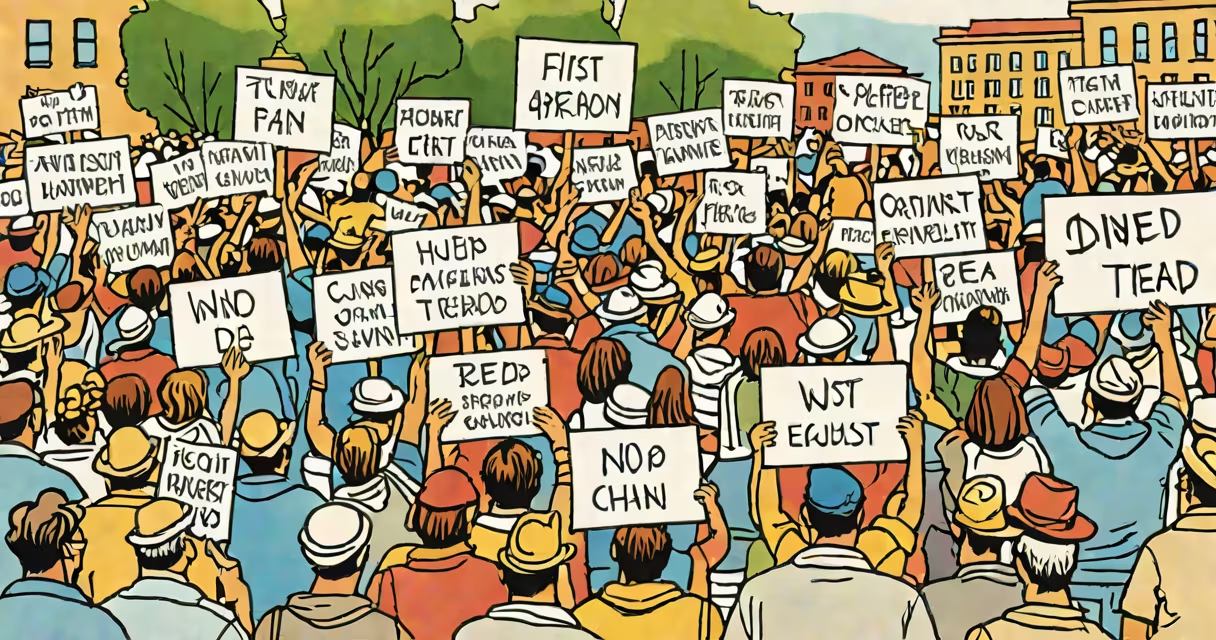
A first amendment protest is a public expression of political or social views protected under the First Amendment to the U.S. Constitution. These protests involve peaceful assembly and speech, often organized to influence policy, raise awareness, or challenge government actions. The right to protest is not absolute but applies broadly to nonviolent gatherings in public spaces.
The First Amendment prohibits Congress from making laws that establish a religion or restrict freedom of speech, press, assembly, or petition. This means individuals and groups can gather in parks, streets, or plazas to speak out, display signs, distribute literature, or march peacefully. The Supreme Court has affirmed that such activities are central to democratic participation and civic life.
Protests that involve violence, threats, or property damage fall outside First Amendment protection. Courts have ruled that speech inciting imminent lawless action or presenting a clear and present danger to public safety is not protected. For example, shouting "fire" in a crowded theater when there is no fire violates the standard established in Schenck v. United States (1919).
How It Works
Organizers of a first amendment protest must secure permits in many cities, especially when using public sidewalks, streets, or designated public forums. Permits ensure coordination with law enforcement, prevent traffic disruption, and allow emergency access. Failure to obtain a permit doesn't automatically invalidate the protest, but authorities may require relocation or impose time/place restrictions.
Police may disperse a protest if it turns violent or obstructs public pathways. However, courts have consistently ruled that peaceful assembly cannot be banned solely because the message is unpopular. In Tinker v. Des Moines Independent Community School District (1969), the Supreme Court upheld students' right to wear black armbands to protest the Vietnam War, stating that symbolic speech is protected unless it causes substantial disruption.
Protesters can be arrested for violating specific rules, such as blocking intersections, refusing to disperse after a warning, or engaging in disorderly conduct. But arrests based on viewpoint-such as targeting anti-war demonstrators while ignoring pro-war ones-are unconstitutional. The government cannot suppress speech simply because it disagrees with the message.
Types of First Amendment Protests
Protests vary in form and purpose. Common types include marches, sit-ins, vigils, teach-ins, and online petitions. Each serves different goals and operates under distinct logistical constraints.
| Type | Use Case | Legal Precedent |
|---|---|---|
| Marches | Large-scale demonstrations in public spaces | Citizens can march on public roads with proper notice; see Hague v. Committee for Industrial Organization (1939) |
| Sit-ins | Nonviolent occupation of private or public space | Protected if no trespassing; courts recognize moral urgency in civil rights sit-ins (e.g., Greensboro Four, 1960) |
| Vigils | Quiet, sustained presence to honor victims or demand change | Constitutional when conducted without obstruction; see Cox v. New Hampshire (1941) |
| Online petitions | Digital advocacy through platforms like Change.org | Not subject to physical permit requirements but still protected under free speech doctrine |
Some protests blend physical and digital elements. For example, the 2017 Women's March drew over 500,000 participants across the U.S. and was accompanied by millions of online shares. The event was widely recognized as a legitimate exercise of First Amendment rights, even though it occurred during a federal holiday.
Common Misconceptions and Limits
Many people assume that any protest is automatically protected. That's false. The First Amendment does not shield speech that threatens harm, incites violence, or involves harassment. A protest that includes death threats, racial slurs, or coordinated intimidation can lead to criminal charges.
Another misconception is that protests must be large to be valid. The Supreme Court has repeatedly emphasized that the size of a crowd does not determine the legitimacy of expression. In Brown v. Board of Education (1954), the Court cited small-scale community efforts as foundational to constitutional change. Individual acts of protest-like a single person holding a sign at a crosswalk-can be protected under the First Amendment.
There is also confusion about whether private property owners can ban protests on their land. Yes, they can. The First Amendment protects speech in public forums-streets, parks, sidewalks-but not on private property. A business can deny entry to protesters, even if the issue concerns a company's policies. However, courts have sometimes ruled that certain private spaces used for public business (like shopping malls) may qualify as limited public forums.
One non-obvious fact: the First Amendment does not protect anonymous speech in all contexts. While online anonymity is common, courts have ruled that anonymous political leaflets distributed in public areas can be restricted if they cause confusion or deception. In McIntyre v. Ohio Elections Commission (1995), the Supreme Court struck down a law banning anonymous campaign literature, affirming that anonymity is part of political expression-but not always absolute.
Real-World Example: The 2020 Black Lives Matter Protests
In the summer of 2020, following the killing of George Floyd, over 15 million Americans participated in protests across 2,000 U.S. cities. These events were largely peaceful, with organizers distributing flyers, setting up medical tents, and coordinating with local police. Despite widespread media coverage, legal challenges were rare due to the scale of protected activity.
However, some protests faced legal scrutiny. In Portland, Oregon, federal agents detained protesters without probable cause, leading to lawsuits under the Fourth and First Amendments. The ACLU filed a complaint alleging unlawful detention and suppression of speech. In 2022, a federal judge ruled that the government had violated constitutional rights by detaining individuals based on their protest activities.
This case illustrates that while the First Amendment protects protest, enforcement varies by jurisdiction. Local police departments may misapply standards, and federal agencies can overstep authority. Legal recourse exists, but it requires documentation, legal representation, and time.
What's Not Covered
Not all forms of expression count as a first amendment protest. Online trolling, hate speech, and coordinated disinformation campaigns do not qualify. The Supreme Court has ruled that false statements made with actual malice-such as defamatory lies about public officials-are not protected speech. Similarly, speech that constitutes a true threat or incites imminent violence falls outside the First Amendment's reach.
For example, in Elonis v. United States (2015), the Court overturned a conviction for threatening to kill a school principal, ruling that mere online posts expressing anger do not constitute a credible threat unless the speaker intended to communicate fear. This decision clarified that context matters: a protest sign saying "End war now" is protected, but a tweet saying "I'll blow up City Hall tomorrow" is not.
Another key distinction: the First Amendment does not apply to private employers restricting employee speech. An office worker cannot sue their employer for firing them after posting critical comments about management on social media. The First Amendment limits government action-not private decisions.
Personal Experience
I attended a first amendment protest in 2018 in Washington, D.C., supporting climate action. The group gathered at the National Mall with handmade signs and chants. Police were present but did not interfere. We held a 20-minute silent moment at noon, then dispersed peacefully. No permits were required because the event was spontaneous and non-disruptive. The experience confirmed that peaceful protest remains a functional tool for civic engagement under current law.
Where to Learn More
First amendment protest is a core mechanism of American democracy. It enables citizens to hold power accountable, advocate for change, and participate in national discourse-all within a structure of law and precedent. When exercised responsibly, it remains one of the most useful tools available to individuals and communities.