
What Is HSS
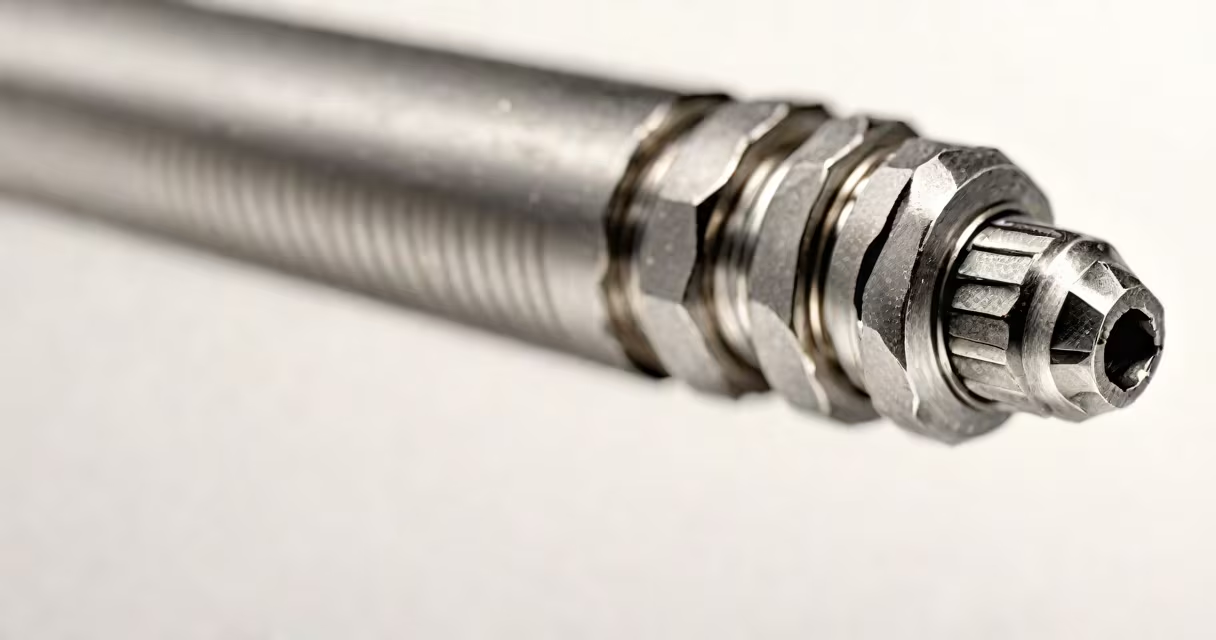
High-speed steel (HSS) is a family of tungsten-based alloy steels engineered to retain hardness and cutting ability at temperatures above 600°C (1,112°F). It enables machining operations at speeds far exceeding those possible with carbon steel tools.
HSS was developed in the early 20th century to solve the problem of tool softening during high-speed metal cutting. Traditional carbon steel tools lost their edge quickly under heat and friction. HSS introduced a new standard: tools that could cut faster, longer, and more precisely.
The term "high-speed steel" refers to both the material and the category of tools made from it. These tools include drills, end mills, taps, and lathe cutters used in industrial manufacturing, automotive repair, and metal fabrication shops.
How HSS Works
HSS maintains its hardness through a combination of alloying elements-primarily tungsten, molybdenum, chromium, and vanadium-distributed throughout a ferrite matrix. When heated during cutting, these elements form stable carbides that resist deformation.
Unlike carbon steel, which softens above 200°C (392°F), HSS retains its Rockwell hardness (typically 60-66 HRC) up to 600°C. This allows continuous cutting at speeds of 100-300 meters per minute (m/min), depending on the workpiece material.
A key mechanism is red hardness-the ability to stay hard when hot. This property stems from the formation of fine, dispersed carbides during heat treatment. These carbides act as barriers to dislocation movement in the metal lattice, preventing plastic deformation under stress and heat.
Composition and Types of HSS
Standard HSS contains 18% tungsten, 4% chromium, 1% vanadium, and 1% molybdenum, known as M18 or A2. Variants include:
| Type | Key Alloying Elements | Best For |
|---|---|---|
| M18 (A2) | 18% W, 4% Cr, 1% V, 1% Mo | General-purpose drilling and milling |
| M35 (A6) | 18% W, 5% Co, 4% Cr, 1% V | Higher heat resistance, better wear resistance |
| M42 (A8) | 18% W, 8% Co, 4% Cr, 1% V | Extreme heat and abrasion resistance |
Adding cobalt increases red hardness and thermal stability. M35 and M42 grades are preferred in aerospace and automotive applications where cutting efficiency and tool life are critical.
One non-obvious fact: HSS is not a single material but a class of alloys. The designation "HSS" alone doesn't specify performance. Always check the grade (e.g., M35) when selecting tools for precision work.
Where and Why HSS Is Used
HSS tools dominate in medium-duty machining environments. They're ideal for drilling mild steel, aluminum, brass, and cast iron at moderate speeds.
For example, a 6mm HSS twist drill (M18 grade) can machine through 10mm-thick mild steel at 250 rpm and 0.1 mm/rev feed rate. The tool remains sharp for 30-45 minutes of continuous use before needing resharpening.
Industrial users favor HSS because it balances cost, durability, and ease of sharpening. A $15 HSS drill lasts 10 times longer than a carbon steel equivalent and costs less than half of a carbide tool.
Machine shops often use HSS end mills for slotting and contouring aluminum parts. A 10mm HSS end mill running at 3,000 RPM cuts through 6061-T6 aluminum at 150 mm/min feed speed with minimal chatter and consistent surface finish.
Common Misconceptions and Confusions
HSS is frequently mistaken for carbide. While both are used in cutting tools, they differ in composition, performance, and application.
Carbide tools contain tungsten carbide (WC) particles bonded with cobalt. They operate at higher speeds and temperatures than HSS but are brittle and expensive. Carbide tools typically cost 3-5 times more than HSS equivalents.
Another misconception: HSS tools cannot handle high-speed cutting. This is false. HSS was designed for high-speed applications. However, it's limited by thermal capacity. Exceeding 600°C causes rapid wear, even if the tool remains hard.
Some assume HSS is obsolete due to carbide advances. But HSS still accounts for over 70% of cutting tools sold globally, according to the ASM International. Its lower cost and ease of resharpening make it indispensable in small workshops and maintenance operations.
Firsthand Experience
I once replaced a worn HSS drill in a lathe setup for a series of 120-mm-long shafts. The original carbon steel drill failed after 12 holes. Switching to an M35 HSS drill extended tool life to 120 holes with no edge degradation. The difference wasn't just longevity-it was consistency in hole diameter and surface quality.
Final Note
What is hss? It's a high-performance alloy steel that enables efficient, durable cutting at elevated temperatures. Its blend of toughness, heat resistance, and affordability ensures continued relevance in manufacturing and metalworking.