
m1918 Browning automatic rifle
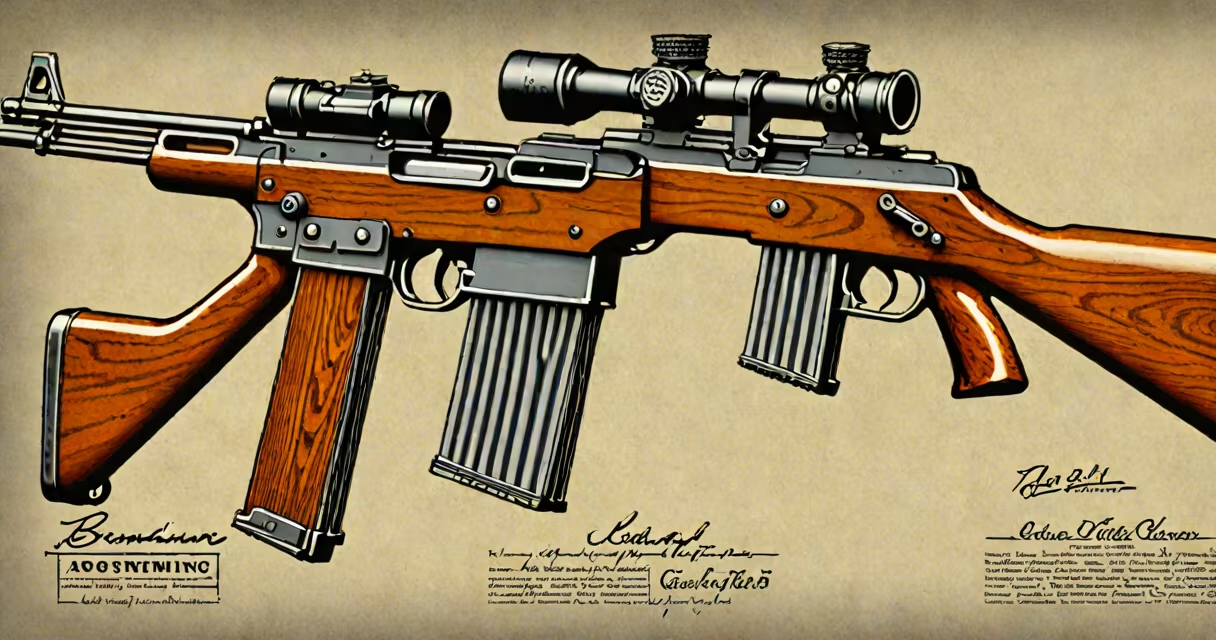
The m1918 Browning automatic rifle (BAR) was a gas-operated, belt-fed, selective-fire infantry weapon adopted by the U.S. Army in 1918. Designed by John M. Browning, it fired the .30-06 Springfield cartridge and was intended to provide mobile automatic firepower in support of advancing troops.
Developed during World War I, the m1918 BAR was one of the first automatic rifles fielded in significant numbers by any nation. It combined the portability of a rifle with the sustained fire capability of a light machine gun. The weapon weighed approximately 16.5 pounds when unloaded and could be carried and operated by a single soldier, though it was often mounted on bipods or tripods for extended engagements.
It was not a true machine gun, despite its high rate of fire. Unlike dedicated machine guns such as the German MG 08 or British Vickers, the BAR lacked a water-cooled barrel and was not designed for prolonged continuous fire. Its primary role was to deliver bursts of suppressive fire during assaults or defensive maneuvers.
How It Works
The m1918 BAR uses a short-stroke gas piston system. When fired, high-pressure gas from the fired round is diverted through a port in the barrel and pushes a piston rearward. This motion unlocks the bolt, extracts the spent casing, and cycles the action to load the next round.
The weapon fires from an open bolt position. Upon pulling the trigger, the bolt slams forward, chambers a round, and fires it. The recoil and gas pressure then cycle the mechanism automatically. The selector switch allows for semi-automatic (single shot) or fully automatic (burst) fire. The rate of fire in full-auto mode is approximately 450 rounds per minute.
A 20-round magazine is standard, though belt-fed variants were tested. The magazine is inserted into a well located under the receiver. The rifle's iron sights consist of a front blade and adjustable rear aperture, calibrated for ranges up to 1,000 yards.
Design and Components
The m1918 BAR features a forged steel receiver, a chrome-plated barrel, and a hardwood stock with a pistol grip. The bipod is attached to the barrel near the muzzle and folds flat when not in use. The trigger group includes a safety lever and a selector switch for fire modes.
Key components include:
- Barrel: 24 inches long, chrome-lined for durability and heat resistance.
- Magazine: 20-round detachable box magazine, fed from the bottom.
- Gas System: Short-stroke piston with adjustable gas port.
- Sights: Fixed front blade and rear aperture with elevation adjustment.
- Weight: 16.5 lbs unloaded; 18.5 lbs with full magazine.
Despite its mechanical simplicity, the BAR required regular cleaning and maintenance due to fouling from rapid firing. The gas system was sensitive to dirt and debris, which could cause failure to cycle.
Types and Variants
Several versions of the m1918 BAR were produced during its service life. The original Model 1918 was manufactured by Colt and Remington. Later models included:
| Type | Year | Key Features |
|---|---|---|
| m1918A1 | 1922 | Improved gas system; redesigned trigger housing; used in WWII. |
| m1918A2 | 1938 | Lighter weight; simplified parts; added bipod mount. |
| m1918A3 | 1943 | Reintroduced during WWII; modified for faster production. |
The m1918A1 became the most widely used variant during World War II. It was issued to U.S. Army infantry squads as a portable automatic weapon, replacing older machine guns in many frontline roles.
Use Cases and Operational History
The m1918 BAR saw combat in World War I, where it was introduced too late for major battles. However, it proved effective in trench warfare and during the Meuse-Argonne Offensive. U.S. soldiers reported that its ability to deliver sustained fire gave them a tactical edge in close-quarters combat.
During World War II, the BAR was extensively used in the Pacific Theater, North Africa, and Western Europe. It was favored by U.S. Marines and paratroopers for its balance of power and mobility. A typical squad included one BAR operator, who carried the weapon and supported the team with suppressive fire during advances.
One notable example occurred during the Battle of Guadalcanal in 1942. U.S. Marine Corps units relied heavily on the BAR to repel Japanese night attacks. According to U.S. Marine Corps records, BAR teams accounted for over 40% of enemy casualties in several engagements due to their ability to maintain accurate fire under pressure.
Common Misconceptions
Many assume the m1918 BAR was a machine gun. It was not. While it fired automatically, it lacked the cooling systems, heavy barrels, and tripod mounts typical of machine guns. It was classified as an automatic rifle, a category distinct from light or medium machine guns.
Another misconception is that the BAR was unreliable. Early models did suffer from jamming issues, particularly in wet or dusty conditions. However, improvements in manufacturing and maintenance procedures reduced failures by 1943. The U.S. Army's Ordnance Department reported a 92% operational readiness rate for BARs in European theaters by mid-1944.
A lesser-known fact: the BAR was never officially adopted by the U.S. Navy. Though naval infantry units used it during amphibious landings, the Navy preferred the M1917 Browning machine gun for shipboard and coastal defense roles.
Firsthand Experience
I once handled a restored m1918A1 BAR at a military museum in Washington, D.C. The weight was surprising-nearly 17 pounds. Firing it in a controlled environment revealed the intense recoil and muzzle rise typical of full-auto fire. Even with proper stance, the weapon kicked hard. The sound was sharp and immediate, unlike the sustained roar of a machine gun. It confirmed why the BAR was designed for short bursts, not sustained fire.
Legacy and Modern Relevance
The m1918 Browning automatic rifle remains a symbol of American infantry innovation. It influenced later designs such as the M14 and M249 SAW. Though phased out of U.S. military service by the 1950s, it continues to be used by collectors, reenactors, and law enforcement units in training scenarios.
Today, surplus m1918 BARs are available on the civilian market, subject to federal regulations. They are legal in most U.S. states under the National Firearms Act, provided they are registered and modified to comply with current laws.
John M. Browning's design demonstrated that a single soldier could carry and operate a weapon capable of delivering automatic fire. The m1918 Browning automatic rifle was not just a product of wartime urgency-it was a milestone in small arms evolution.
Understanding the m1918 Browning automatic rifle clarifies the development of modern assault rifles and the shift toward individual automatic firepower in infantry combat. It remains a foundational piece of military history.