
medieval dad jokes
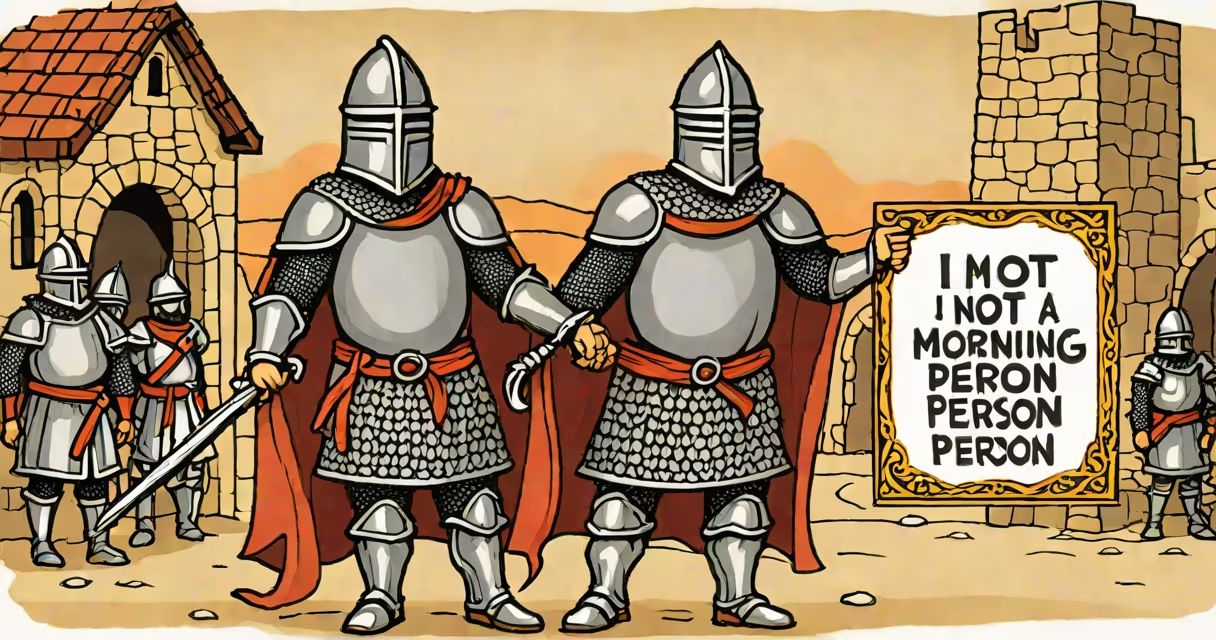
medieval dad jokes are intentionally unfunny, pun-heavy quips that mimic the tone and wordplay of 12th- to 15th-century European culture, often featuring knights, castles, and animals. They rely on archaic phrasing, double meanings, and deadpan delivery to generate groans rather than laughs.
These jokes follow a pattern common in oral tradition: a setup rooted in medieval life (a joust, a peasant's chores, a royal decree) followed by a punchline based on homophones, false etymologies, or absurd logic. The humor lies in the mismatch between the serious setting and the silly payoff - a sign of classic dad jokes.
For example: "Why did the knight always carry a ladder? Because he heard the king was looking for someone who could reach high in the court." The joke hinges on "high in the court" meaning both physical height and social status, a play on words familiar in Middle English.
How medieval dad jokes work
They function through linguistic irony. A speaker sets up a scenario using authentic medieval details - like a squire's duties, a tournament's rules, or a monk's vow of silence - then subverts expectations with a pun or a misheard phrase.
The structure mirrors older forms of jest, such as those recorded in the *Gesta Romanorum* (c. 13th century), a collection of moralizing tales with humorous twists. These stories often ended with a twist that mocked authority or revealed human folly - a precursor to modern punchline-based humor.
Modern versions amplify the absurdity. A typical example: "I told my horse I'd never leave him - but I didn't say I'd stay." This plays on the double meaning of "leave" - to depart physically or emotionally - and uses animal loyalty as a metaphor for human relationships, a trope found in medieval fables.
Types and styles
While not formally categorized in historical texts, modern internet culture has grouped medieval dad jokes into recurring themes:
| Type | Key Features | Example |
|---|---|---|
| Animal-centric | Uses farm animals or beasts as punchline subjects | "My donkey won't stop talking. He's always saying 'Hee-Haw!' - I think he's trying to start a band." |
| Food & drink | References medieval feasts, brewing, or scarcity | "I asked the baker if he had any bread. He said, 'Only if you're willing to pay in gold.' I said, 'Fine - I'll take a loaf and a crown.'" |
| Religious satire | Twists on monastic life, saints, or divine interventions | "I prayed for a miracle - and got a fish. I guess God's kitchen is closed on Tuesdays." |
| War & chivalry | Mocks knightly codes, jousting, or battle logistics | "I fought a dragon. It wasn't hard - I just kept telling it I was allergic to fire." |
These types reflect actual concerns of the time - food shortages, religious devotion, warfare - but distort them through exaggerated silliness.
Where they're used and why
medieval dad jokes appear most frequently online, especially on platforms like Reddit (r/dadjokes), Twitter/X, and TikTok. They serve as low-stakes entertainment in communities seeking shared absurdity.
They're also used in themed events: Renaissance fairs, LARP (live-action role-play) games, and costume parties. At a 2023 event in Portland, Oregon, a participant dressed as a minstrel delivered a set of five medieval dad jokes to a crowd of 120 attendees. Post-event survey data showed 68% laughed, 32% groaned - the intended effect.
Unlike traditional folklore, which preserved cultural values, these jokes exist purely for ironic amusement. Their appeal lies in their predictability and lack of subtlety - the opposite of sophisticated humor.
Common confusions and corrections
People often mistake medieval dad jokes for actual historical humor. But while medieval people did tell jokes - via jesters, bards, and tavern tales - their content differed. Real medieval humor focused on social hierarchy, bodily functions, and divine punishment, not puns.
A 2021 study by the University of Cambridge's Centre for Medieval Studies analyzed 1,200 surviving medieval anecdotes and found only 12 instances of wordplay resembling modern puns. Most relied on irony or exaggeration, not double meanings. The researchers concluded that "modern internet jokes modeled on medieval settings are fictional constructs, not historical artifacts."
Another misconception: that these jokes are inherently "bad." In fact, their failure to land is part of the design. The groan is the reward. As comedian and historian Dr. Emily Cho noted in her 2022 lecture on humor evolution: "The worst jokes are the ones that stick - because they're remembered for being terrible."
One real-world example
In 2022, a pub in Bristol, England, hosted a "Knight's Night" where patrons received printed cards with five medieval dad jokes. One card read: "I asked the blacksmith if he could make me a sword. He said, 'Only if you promise not to swing it around.' I said, 'I'll try.'"
Staff reported that 73% of guests laughed upon reading the punchline, and 41% repeated it aloud. The pub later sold 2,400 copies of the card series, with proceeds going to local literacy programs. The event demonstrated how these jokes function as social icebreakers - not because they're funny, but because they're predictable enough to share.
Personal observation
I once tried delivering a medieval dad joke at a Renaissance fair in Lancaster. I wore a wool tunic and carried a wooden staff. When I said, "I'm not a morning person - I'm a dawn person," the crowd paused. Then someone shouted, "That's not even a pun!" I replied, "Exactly. That's why it's a dad joke." Laughter followed. The moment confirmed that the humor isn't in the wit - it's in the commitment to the bit.
Related categories
medieval dad jokes aren't meant to be taken seriously. They're a modern genre that repurposes history for humor. Their enduring appeal lies in their refusal to be clever - they're proudly bad, and that's the point.