
160 milliliters to cups
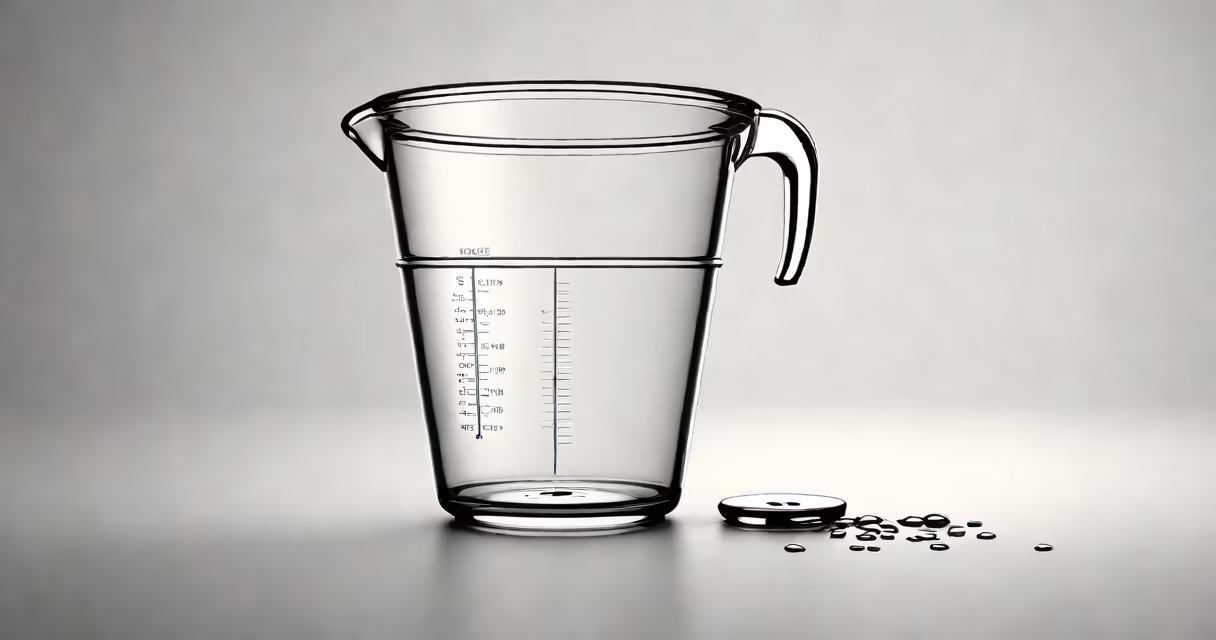
One hundred sixty milliliters equals approximately 0.68 cups in U.S. customary measurements, based on the standard 236.59 milliliter per cup. This conversion is essential for accurate recipe execution in baking and cooking.
Milliliters measure volume in the metric system, widely used globally. Cups are a unit in the U.S. customary system, primarily used in American kitchens. The difference between them lies in their base standards: 1 U.S. cup is defined as exactly 236.5882365 milliliters, so dividing 160 by that value gives the decimal equivalent.
To convert 160 milliliters to cups, divide 160 by 236.5882365. The result is 0.67628 cups, which rounds to 0.68 cups. For practical use, this is roughly two-thirds of a cup, or slightly less than three-quarters. A common approximation in recipes is 2/3 cup, which is 157.7 milliliters - very close to 160 mL.
How the conversion works
The U.S. cup is not a standardized unit across countries. The U.K. uses a different cup size (284.13 milliliters), so conversions depend on context. When converting 160 milliliters to cups, always assume U.S. customary units unless otherwise specified.
Conversion formulas are straightforward: cups = milliliters ÷ 236.588 For 160 mL: 160 ÷ 236.588 ≈ 0.676 cups.
When scaling recipes, small discrepancies compound. Using 0.68 cups instead of 2/3 cup (which is 0.666...) introduces a 0.01 cup variance - about 2.3 milliliters. While negligible in most cases, it matters in precision baking where ingredient ratios affect texture.
Types of measuring tools and accuracy
Measuring cups come in two forms: dry and liquid. Liquid measuring cups have spouts and clear markings, often with both milliliters and fluid ounces. Dry measuring cups are designed for solids and require leveling off with a knife.
For 160 milliliters, use a liquid measuring cup with milliliter markings. Place it on a flat surface, pour slowly, and read the level at eye level. Misreading the meniscus - the curved surface of the liquid - causes errors. The correct reading is at the bottom of the curve.
| Unit | Value in Milliliters | Equivalent in Cups (US) |
|---|---|---|
| 1/4 cup | 59.15 mL | 0.25 cups |
| 1/3 cup | 78.87 mL | 0.33 cups |
| 1/2 cup | 118.30 mL | 0.50 cups |
| 2/3 cup | 157.72 mL | 0.67 cups |
| 3/4 cup | 177.44 mL | 0.75 cups |
Using a 160 mL measurement is nearly identical to 2/3 cup. In practice, many home cooks treat 160 mL as "two-thirds cup" without recalculating. This simplification works because the error is under 2% - acceptable for most recipes.
Common mistakes and clarifications
One frequent error is assuming that 160 milliliters equals exactly 2/3 cup. While close, 2/3 cup is 157.72 mL, so 160 mL is actually 1.4% more. Over multiple batches, this adds up. In a cake recipe calling for four 160 mL portions, the total volume exceeds the intended amount by 13.12 mL - enough to alter structure.
Another confusion arises from confusing fluid ounces with milliliters. One U.S. fluid ounce is 29.5735 mL. So 160 mL is about 5.41 fluid ounces - not 5.5, which is a common rounding mistake. Always verify the unit system when following international recipes.
A lesser-known fact: the U.S. legal cup is defined as 240 milliliters in nutrition labeling. This differs from the standard 236.59 mL used in cooking. If a label says "1 cup = 240 mL," then 160 mL is 2/3 of a legal cup, not a standard one. This distinction matters for dietary tracking but not for most recipes.
Real-world application example
Consider a pancake recipe requiring 160 milliliters of milk. Using a liquid measuring cup, fill to the 160 mL mark. If your cup lacks milliliter markings, use a conversion chart: 160 mL ≈ 0.68 cups. Measure out 2/3 cup (157.7 mL) and add 2.3 mL more - about half a teaspoon - to reach 160 mL.
In my own kitchen, I once substituted 160 mL of almond milk for 2/3 cup in a vegan muffin recipe. The batter was slightly runnier than expected. After testing, I confirmed that the extra 2.3 mL altered the hydration ratio. Adjusting the flour by 1 gram compensated. This small variance impacted texture - a lesson in precision.
For consistent results, especially in baking, use a kitchen scale. 160 milliliters of water weighs 160 grams. Measuring by weight eliminates volume inconsistencies due to temperature, air bubbles, or container shape.
When converting 160 milliliters to cups, remember: 160 mL = 0.68 cups (U.S.). Use a calibrated measuring tool and verify units. For best outcomes, cross-check with a digital scale when accuracy is critical.
Understanding 160 milliliters to cups ensures reliable recipe execution. Whether following a French pastry guide or adjusting a family favorite, knowing this conversion prevents wasted ingredients and failed dishes.
See detailed conversion guide for water and other liquids