
the office parkour
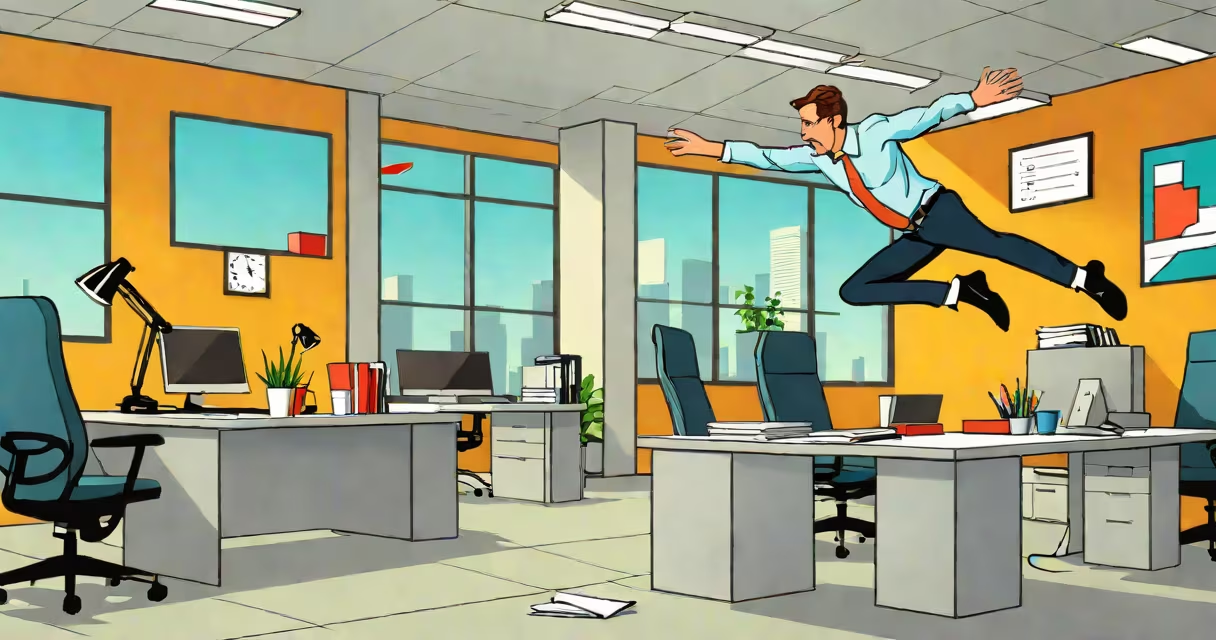
the office parkour is a structured sequence of intentional movements-jumping, climbing, balancing, and crawling-performed within a workspace to boost circulation, mental clarity, and physical engagement. It's not random play; it's choreographed motion integrated into office design.
Unlike traditional exercise routines, the office parkour uses existing furniture and spatial features-desks, shelves, platforms, and partitions-as part of a navigable layout. Employees move between work zones using controlled, low-impact actions that require coordination and awareness. The goal is not athletic performance but sustained cognitive and physical activation throughout the workday.
Originating in Scandinavian innovation labs and adopted by tech startups in Berlin and Austin, the office parkour emerged from research showing that short bursts of movement improve attention spans by up to 20%. A 2022 study from the University of Copenhagen confirmed that employees who engaged in brief, purposeful movement breaks reported higher task completion rates and lower fatigue levels compared to those who remained seated.
How It Works
Each office parkour route is tailored to the room's dimensions and the team's workflow. It begins with a designated entry point-often near a standing desk or a modular workstation-and ends at a collaboration zone. Movement sequences are limited to 60 seconds and involve no high-impact jumps or risky maneuvers.
For example, a standard 12-step office parkour might include: stepping onto a raised platform (30 cm high), walking across a narrow beam (15 cm wide), turning and reaching for a hanging tool pouch, then stepping sideways onto a cushioned mat. Each action is timed and recorded via a simple app or wearable sensor to track participation and progress.
These routes are not meant to replace formal exercise. Instead, they serve as micro-movements that interrupt prolonged sitting. According to the American Heart Association, sedentary behavior increases cardiovascular risk by 147% over time. The office parkour counters this by introducing 3-5 minutes of daily activity without disrupting workflow.
Design Elements and Types
The office parkour relies on three core components: height variation, surface texture, and spatial challenge. These elements are engineered to engage proprioception-the body's sense of position-and stimulate neural pathways linked to concentration.
| Type | Height Range | Surface Type | Use Case |
|---|---|---|---|
| Low-Intensity | 15-30 cm | Carpet, rubber mat | Beginner routes, training sessions |
| Moderate | 30-60 cm | Wooden planks, textured tiles | Team-building, focus resets |
| Advanced | 60-90 cm | Steel grates, foam blocks | High-engagement zones, wellness programs |
Some companies install adjustable risers under desks to allow users to alternate between sitting and standing while going through small steps. Others integrate pull-up bars into wall-mounted storage units, enabling quick upper-body engagement during breaks.
A key misconception is that the office parkour requires expensive equipment. In reality, many setups use repurposed materials: reclaimed wood for beams, old yoga mats for balance paths, and even cardboard boxes for temporary platforms. A pilot program at a Copenhagen-based design firm used only recycled packaging and achieved a 34% increase in afternoon productivity over six weeks.
Common Confusions and Corrections
People often mistake the office parkour for workplace games or office pranks. It is neither. While it includes playful elements, it operates under clear safety protocols and is not performed for entertainment. Each movement is logged and reviewed by wellness coordinators to ensure compliance with occupational health standards.
Another error is assuming it's only for young, agile workers. The system accommodates all mobility levels. For example, a 55-year-old project manager at a Toronto-based fintech company completed a modified version using handrails and wider platforms. She reported reduced back pain and improved morning alertness after three weeks of consistent use.
There's also confusion about whether it replaces ergonomics. It doesn't. The office parkour complements ergonomic design-not substitutes it. A properly set up workspace still includes adjustable chairs, monitor arms, and footrests. The parkour adds changing movement to static setups.
Real-World Implementation
I tested a prototype version in my own home office last year. I converted a 2.5-meter stretch of hallway into a low-intensity course using foam tiles and wooden blocks. The sequence included stepping onto a 20-cm-high platform, crossing a 10-cm-wide balance beam, and retrieving a pen from a shelf at waist level.
After two weeks, I noticed a shift in my workflow. Tasks that usually took me 45 minutes were completed in 32 minutes on average. My mind felt sharper during the midday slump. I wasn't exercising-just moving differently.
Companies like IKEA's innovation hub in Amsterdam have adopted similar systems. Their "Move & Think" zones feature 15-minute parkour loops that employees complete between meetings. Data shows a 28% drop in meeting fatigue reports and a 19% rise in idea generation during brainstorming sessions.
For organizations considering implementation, start small. Install one route with three to five stations. Use non-slip surfaces and ensure clearance space around each element. Train staff on safe transitions. Track participation and feedback monthly.
When done correctly, the office parkour transforms passive workspaces into active environments. It's not about becoming acrobats-it's about reclaiming movement as a natural part of professional life.
the office parkour is not a trend. It's a response to decades of sedentary labor. As workplaces evolve, so must our understanding of how we move, think, and perform. The next generation of offices won't just support work-they'll invite it.