
bachelor in electronics engineering
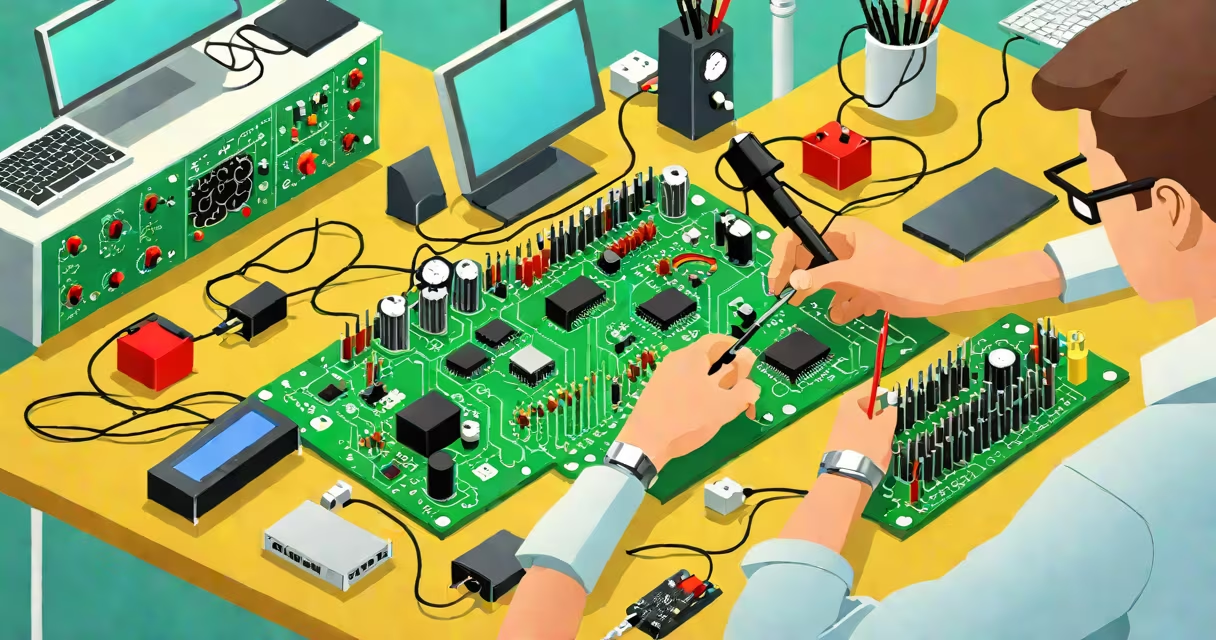
A bachelor in electronics engineering is an undergraduate academic degree that equips students with the technical knowledge and practical skills to design, test, and manage electronic systems, including microcontrollers, sensors, power supplies, and communication devices. The program typically spans four years and includes coursework in analog and digital electronics, signal processing, control systems, and embedded software.
This degree focuses on the physical and computational aspects of electronic components and their integration into functional systems. Graduates work in industries ranging from consumer electronics and telecommunications to aerospace, medical devices, and robotics. Core competencies include circuit analysis, PCB layout, firmware development, and system-level troubleshooting.
According to the U.S. Bureau of Labor Statistics, employment of electrical and electronics engineers is projected to grow 2% from 2022 to 2032, with steady demand in defense, healthcare, and renewable energy sectors. The median annual wage for electronics engineers was $103,620 in May 2023.
How a bachelor in electronics engineering works
Students begin with foundational courses in mathematics, physics, and basic electrical principles. By the second year, they take specialized classes such as semiconductor devices, digital signal processing, and RF (radio frequency) systems. Laboratory sessions reinforce theoretical concepts through hands-on projects like building a wireless sensor node or programming a microcontroller to control motor speed.
Capstone projects in the final year require teams to develop a complete electronic system-from concept and schematic design to prototyping and testing. One team at the University of California, San Diego designed a low-power wearable device that monitors heart rate and alerts users via Bluetooth when irregularities occur. The project integrated a microcontroller, ECG sensor, and custom PCB, demonstrating real-world application of classroom learning.
Internships are common during summers or between semesters. Many programs partner with companies like Texas Instruments, Analog Devices, and Lockheed Martin to provide industry exposure. These experiences often lead to job offers upon graduation.
Core components and specializations
The curriculum centers on hardware and software integration. Key subjects include:
- Linear and nonlinear circuit theory
- Microprocessor architecture and assembly language
- Control systems and feedback loops
- Electromagnetic compatibility and signal integrity
- Power electronics and energy conversion
Some schools offer concentrations in areas such as embedded systems, robotics, or biomedical electronics. For example, Northeastern University's program allows students to focus on wearable health tech, combining electronics with physiology and data analytics.
| Program Focus | Typical Coursework | Common Career Paths |
|---|---|---|
| Embedded Systems | Real-time operating systems, ARM Cortex-M programming, sensor fusion | IoT device engineer, firmware developer |
| Power Electronics | DC-DC converters, inverters, motor drives | Renewable energy systems engineer, EV battery designer |
| Communications & RF | Antenna design, modulation techniques, SDR (software-defined radio) | Telecom network engineer, satellite systems specialist |
Where and why it's used
Electronics engineering underpins nearly every modern device. Smartphones contain over 1,000 electronic components, including processors, memory chips, and wireless transceivers-all designed by electronics engineers. Medical imaging equipment like MRI machines rely on precise signal conditioning and high-speed data acquisition systems developed by this field.
Automotive applications are another major area. Modern vehicles use hundreds of electronic control units (ECUs) to manage engine performance, braking systems, and driver assistance features. A bachelor in electronics engineering qualifies individuals to contribute to advanced driver-assistance systems (ADAS), such as adaptive cruise control and automatic emergency braking.
For example, Tesla's Autopilot system uses multiple cameras, radar, and ultrasonic sensors connected through a central electronic architecture. Engineers with this degree play key roles in developing the sensor fusion algorithms and hardware interfaces that make autonomous driving feasible.
Common misconceptions and distinctions
A bachelor in electronics engineering is not interchangeable with a bachelor of science in computer engineering, though both involve digital systems. Computer engineering emphasizes processor architecture, operating systems, and software-hardware co-design. Electronics engineering places heavier emphasis on analog circuits, power management, and physical signal behavior.
It is also distinct from a bachelor of automotive engineering, which focuses on vehicle dynamics, propulsion systems, and mechanical design. While automotive engineers may work on electronic subsystems, their training prioritizes mechanics and thermodynamics over circuit-level design.
Another misconception is that electronics engineers only work with hardware. In practice, they frequently write firmware using languages like C, Python, or MATLAB. A project at MIT's Media Lab involved designing a low-cost EEG headset for mental health monitoring. The team included electronics engineers who wrote the signal filtering code and calibrated the analog front-end to reduce noise from muscle movement.
One non-obvious difference: electronics engineers often work with tolerances and environmental factors that software developers rarely consider. A circuit designed for outdoor use must withstand temperature swings from -40°C to +85°C, moisture, and vibration. This requires careful component selection and thermal modeling-skills taught explicitly in electronics curricula but absent in most computer science programs.
I once observed a student team at a regional engineering competition fail to qualify because their robot's motor controller overheated during a demo. The issue stemmed from inadequate heat sinking and poor power distribution-problems rooted in fundamental electronics principles. Their solution required redesigning the PCB layout and adding thermal vias, highlighting how deeply hardware constraints shape real-world outcomes.
A bachelor in electronics engineering delivers the specialized expertise needed to build the physical layer of the digital world-transforming abstract ideas into functioning electronic systems that power modern life.